
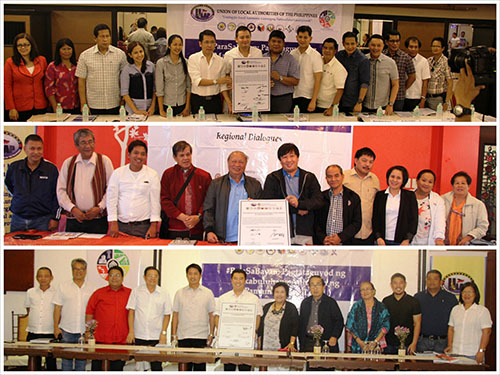
 ULAP convened local government officials among its member leagues, particularly the League of Provinces of the Philippines (LPP), League of Municipalities of the Philippines (LMP), League of Cities of the Philippines (LCP), Liga ng mga Barangay sa Pilipinas (LNB), League of Vice Governors of the Philippines (LVGP), Philippine Councilor’s League (PCL) and National Movement of Young Legislators (NMYL) for the Regional Dialogues of the “#ParaSaBayan: Pagtataguyod ng Makabuluhang Adhikain ng Pamamahalang Lokal” advocacy in Central Luzon (January 25, 2016) in Tarlac City, CAR (January 26, 2016) and Ilocos Region (January 28, 2016) in Vigan City.
#ParaSaBayan was launched on December 2, 2015 during the ULAP National Executive Board (NEB) meeting and has since conducted dialogues and consultation in the following regions: Puerto Princesa City on November 24, 2015 for MIMAROPA, Cebu City on December 11, 2015 for Cebu and Negros Island Regions and Butuan City on December 16, 2015 for CARAGA .
The #ParaSaBayan advocacy, through gathering commitments of the local government officials, pushes for a set of key reforms that empower local governance actors – LGUs and civil society organizations alike – such as direct access and downloads to local government shares in national wealth, performance measurements and incentives, improved financing guidelines for basic services, and improvement of inclusive local government platforms. These key local reforms are informed by the spirit of devolution and decentralization of governance and development espoused in the Local Government Code of 1991, which would be celebrating 25 years of passage in October 2016.
ULAP developed the #ParaSaBayan advocacy to open spaces for consensus-building and collaboration among local governance champions. The gains of the advocacy will inform the continuing agenda of the local governments beyond the Code anniversary.
According to Governor Albert Garcia of Bataan during the Region 3 dialogue held in Tarlac on January 25, 2016, the local governments are the face of the whole government because they are more accessible to the people. There is a need to be more responsive to the growing needs of Filipino people, and both national and local governments must recognize policy reforms that strengthen the capacities of local governance actors.
Sustainability and Institutionalization of Performance-based Incentive Programs
According to DILG Undersecretary Austere Panadero, after the passage of the Code, the national government has provided capacity building and trainings to the local governments to provide guidance on how to perform their functions. In 2000s, it started to measure the capacities of the local governments by setting-up and creating performance indicators based on what is in the Code through the Local Government Performance Management System (LGPMS).
While in the 2010 up to today, further performance measurements were developed – such as the Seal of Good Housekeeping (SGH), which is the award for transparency and disclosure, and the Seal of Good Local Governance (SGLG), which is the upgraded, expanded version of the SGH which includes service delivery indicators. Moreover, these performance measurements are now tied to access to financing facilities, such as the Performance Challenge Fund (PCF), the Bottom-Up Budgeting (BuB), and the newly-started Konkreto at Ayos na Lansangan at Daan Tungo sa Pangkalahatang Kaunlaran (KALSADA) for provincial road maintenance and rehabilitation.
These said programs have provided incentives through downloading of funds to the local governments, who passed certain governance criteria such as transparency and accountability, for the implementation of projects and programs in their communities.
“What is good right now is that we are not looking at personality-based but policy-based, which means the (programs) are looking at our capacities and commitment to good governance. The partnership of the local governments and the national government looks at how to make the resources more felt at the grassroots level,” said Governor Garcia.
During the regional dialogue in the Cordillera Autonomous Region (CAR) on January 26, 2016, Benguet Governor Nestor Fongwan said, “Local government units are feeling that they are being consulted and their needs are being met by the national government (through these performance-based incentive programs).”
Pursuing Meaningful Agenda for Local Governance Reforms
The regional dialogues also focus on other local governance reforms in strengthening the roles of the local governments in achieving development that will trickle down to the people. These reforms seek to further empower while uphold accountability among LGUs in their mandate of delivering services in the frontlines of the development agenda.
During the dialogue in Ilocos Region, Governor Ryan Singson of Ilocos Sur noted that current programs of the national government provides additional support and capacity for the local governments, however, systems reform must be introduced to speed up the processes of releasing local shares from the national wealth, particularly on excise taxes on tobacco and mining.
The local government officials also discuss the review of the Local Government Code, particularly on increasing the share of the local governments in Internal Revenue Allotment (IRA) and revisiting the computation and distribution, to address issues of inequity among the local governments.
Moreover, the local governments are seeking to improve health financing guidelines and co-sharing of expenditures between the national government and local governments to enhance local health systems. They are also keen on developing performance-based mechanisms for local education financing that will empower local governments to more effectively respond to local education needs. The same policy approach is pushed for reforms in the National Disaster Fund and People’s Survival Fund to allow local governments to be more responsive during natural disasters.
Lastly, to ensure that the programs and projects are more targeted and evidence-based, the local governments want the national government to develop an ICT Policy Framework to assist LGUs in financing and investing on ICT infrastructure and programs that will make local data more transparent and efficient. This will allow innovations in technologies that can open spaces for greater and wider participation of more sectors in the governance agenda.
The #ParaSaBayan advocacy will continue on with consensus-building and agenda-setting activities, such as policy workshops and dialogues with potential champions of the local government agenda both in the local and national levels.
The #ParaSaBayan advocacy is being conducted in partnership with the Department of Interior and Local Government (DILG), Department of Budget and Management (DBM), Philippine Open Government Partnership (OGP) Steering Committee, United Nation’s RePubliko advocacy, and Microsoft Philippines.
Local Governance Summit 2024: ULAP and DILG Forge Pathways for a Bagong Pilipinas in Ph LGUs
The Local Governance Summit 2024, organized by the Department of the Interior and Local Government (DILG) and the Union of Local Authorities of the Philippines (ULAP), convened over 4,000 local government officials and stakeholders at the Philippine International Convention Center on August 22-23, 2024. This year’s summit, themed “LGUs sa Bagong Pilipinas: Smart. Resilient. Driven.”, set the stage for local chief executives, elected officials, and other key players in governance to deliberate on critical innovations and strategies to advance local governance in the country.
The summit underscored the importance of local government units (LGUs) in achieving the national vision of a “Bagong Pilipinas,” or a New Philippines—one that is smart, resilient, and driven. The event provided a platform for sharing best practices, showcasing innovations, and discussing pressing challenges that LGUs face as they strive to improve public service delivery and meet the Sustainable Development Goals (SDGs).

Day 1: Setting the Stage for Smart Governance
Day 2: The Future is Local!